
3 minutes
The subject of Fundamental Physics often gives students headaches because it includes complex problems with a substantial mathematical component.
However, it is a fascinating natural science that has contributed enormously to helping us understand the world around us and advance technologically. To help you understand fundamental physics and achieve good exam results , we suggest the following tips.
How can you study fundamental physics and survive the experience?
#1 Master the basic concepts:
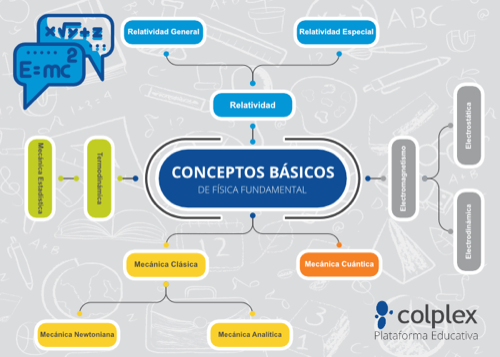
Fundamental physics is based on a series of main theories from which everything else develops. Therefore, the problems we need to solve on an exam are very likely to revolve around these concepts and their variations.
Instead of trying to memorize complex problems, it is advisable to gain a solid understanding of the basic concepts and theories. This will help us understand the underlying principles and connections between different topics.
Mind maps are a very effective method for gaining an overview of these elementary physics concepts and their relationships.
#2 Strengthen your mathematical foundation:
As we have already mentioned, fundamental physics involves a lot of mathematics, so mastering that subject is also highly advisable in order to tackle its many formulas and problems confidently. Reviewing mathematics or studying it alongside fundamental physics will therefore improve our ability to handle the formulas and numbers we encounter.
#3 Simplify:
Try to simplify the situation as much as possible. Problems are often simpler than they appear on first reading. It is important to stay calm and try to relate the problem to a real-life situation we are familiar with, so we can visualize the situation and what we need to find out.
#4 Use drawings:
An excellent way to apply the previous point is through drawings or graphical representations. We have already discussed the benefits of mind maps, but drawings can also be essential when studying and understanding fundamental physics. Whenever possible, it is advisable to make a drawing to illustrate a concept, whether we are studying or solving a problem.

#5 Use flashcards:
Write down any new words, units of measurement, statements of general principles, and other previously unfamiliar concepts you encounter. This will help you keep up with the subject and reinforce the theory, which will have very positive effects when you tackle problem-solving.
Flashcards or study cards allow you to arrange all this information in an organized way and make it easier to study later.
These 5 techniques are helping many fundamental physics students at every level, especially when they are used together.
However, every student has their own way of learning and absorbing knowledge, so we recommend trying different techniques to discover which ones work best for you.
Finally, share your experience with us:
What techniques do you use to study fundamental physics?
Source: goconquer.com