
4 minutes
Although there is no “recipe” that works in every learning context, we have carefully selected a collection of educational practices that can help your institution bring about real change in today's educational paradigms.
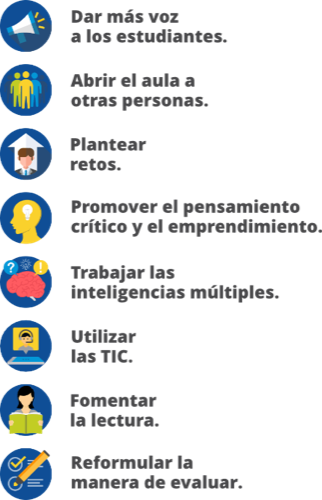
1. Give students more of a voice
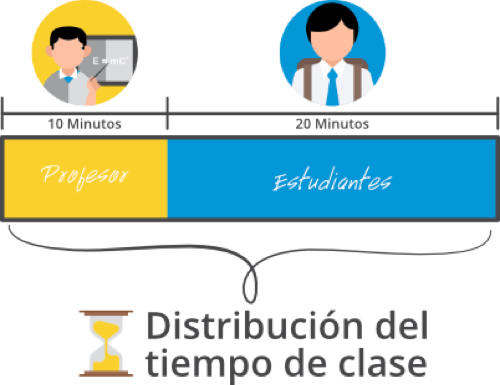
As a general rule, a teacher should not speak for more than one-third of class time. Students should have the floor for the other two-thirds.
We must move away from lectures to achieve meaningful student learning. This can be accomplished through:
- Debates.
- Individual and group presentations.
- Using the 📝 flipped classroom method.
- Film discussions.
2. Open the classroom to other people.
It is worthwhile for the voice heard in the classroom to belong to someone other than the teacher or students at least once a month.
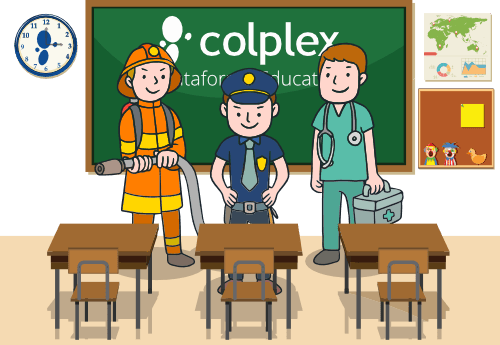
The classroom should welcome other people (students' relatives, other teachers at the institution, professionals from different fields, writers, painters, etc.) to explain their experiences and share their knowledge. This can be very motivating and enriching.
3. Set challenges.
For learning to be meaningful , teachers cannot focus exclusively on passing on facts and concepts for students to memorize.
Their curiosity must be sparked through challenges they need to solve by finding information, researching, and asking questions.
Although teachers often need to promote these practices, implementing them at the academic institution's administrative level will bring about real changes throughout the school.
Implementing the STEAM methodology is a very interesting strategy for beginning to break down today's educational paradigms:
4. Encourage critical thinking and an entrepreneurial mindset.
It was 📝Jean Piaget who said that «The principal goal of education is to create people who are capable of doing new things, not simply repeating what other generations have done.» That is why, at least once a week, students should suggest topics that interest them about their surroundings or current events, so they can debate them, express opinions, and propose possible solutions.
5. Develop multiple intelligences.
Educational institutions are, all too often, places with no room for emotions and feelings. Implementing an educational methodology based on 📝multiple intelligences is extremely important
Paying particular attention to 📝emotional education since it is a basic tool for avoiding problems in getting along with others and a fundamental element in acquiring knowledge meaningfully.
Systematic classroom work on aspects related to emotions must therefore have a priority place among every teacher's goals.
You can implement the methodology of 📝 multiple intelligences using ICT.
6. Use ICT.
Everyday but well-implemented use of ICT in the classroom is an open window to the world that no school should lack.
However, it is not about using it for its own sake. It is about taking advantage of what it offers to make teaching more active and provide individualized attention to students.
ICT must be combined with “traditional methods”: students should read on screens but also on paper, and write with a keyboard but also with pencils and pens.
8. Encourage reading.
Reading comprehension is essential for accessing knowledge. Reading should therefore be a daily classroom activity and a moment shared by students and teachers.
Reading whatever appeals to them for at least 15 minutes every day is an essential practice for acquiring good reading comprehension and fluency.
The best thing an educational institution can do is create a space devoted 📝 exclusively to reading.
10. Rethink assessment methods.
We must question the idea that exams assessing the ability to retain concepts are the most effective. This is one of the fundamental changes needed to achieve a new way of teaching in our educational institutions.
None of the above makes sense if students ultimately feel that passing is all that matters and that doing so only requires retaining the fundamental concepts covered in class.
Assessment must be continuous, with ongoing improvement processes implemented to reduce the weight of traditional exams to a minimum.
In summary, we believe that integrating all these small changes into an educational institution helps it truly achieve a significant improvement in educational quality.