
5 minutes
The society we live in is constantly changing and evolving. Doing nothing can cause major problems. If the landscape is changing and we keep doing the same things, our educational institution will most likely reach a point where it stands on the brink of failure and disappearance.
In this sense, innovation has become a necessity, coming to be considered the true driving force of our educational institution.
Where should we begin?
The key to innovation in an educational institution is the "principal." A good principal must possess and manage a range of abilities to help lead the institution: leadership, authority, capability, and the ability to make optimal use of time devoted to learning and of human, physical, and material resources.
What qualities should a good school principal have?

Principals of educational institutions at any level and in any form of education must use various administrative techniques to lead and optimize the institution's internal control.
How can you innovate at your institution in eight steps?
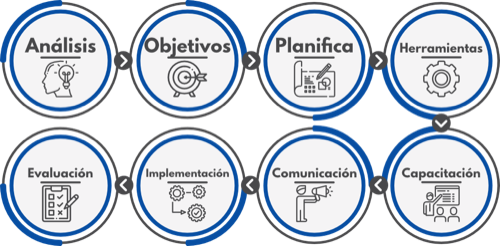
1. Situation analysis.

The first step is to study the educational institution and become aware of its current situation to determine the starting point. You can use this list to identify what to consider:
- The infrastructure: library, recreational areas, sports areas, internet connection, computers, and others.
- Methodological approaches: it is important to analyze whether all teachers at the institution use a sound educational process.
- Digital competency: assess the teaching staff's digital readiness.
- Communication: one of the most important aspects and the key to success for an innovative educational institution is involving parents in education. Assess your institution's ability to communicate and share information with families.
2. Diagnosis and goal definition.

Considering the information gathered during analysis, the next step is to identify the institution's strengths and needs and establish the objectives to be achieved.
The most important thing is to set the main objective and approach change with a vision for the future: know where the institution wants to go, its mission, and what kind of students it wants to develop. In this way, change will achieve the desired "improvement in education" and give the institution its own distinctive value.
3. Designing the innovation plan.

It is time to act. Planning processes leading to innovation at your institution will clearly vary according to the needs identified and objectives established. However, some points should be considered:
- Establish the educational approach the institution will follow and the methodologies it will implement, always seeking an approach close to real life, meaningful and oriented toward bringing out the best in every student, while ensuring analysis and consolidation of knowledge beyond practice.
- Determine priorities for implementing the innovation process: resources, devices, materials, infrastructure and equipment, personnel, spaces, and organization of the institution or classroom, among others.
- Define the entire team's training needs, 📝 how to bring it together and motivate it. Consider the different attitudes this type of activity may provoke among teachers to establish a plan for motivating and generating enthusiasm and expectations.
- Appoint a coordinator or create a coordination team to lead the process alongside management.
- Define an action timetable.
- Set the phases of the educational plan and the tasks to be carried out in each, both by the institution's management and administration and by the teaching team.
4. Selecting tools and technology.

Choose high-quality resources, materials, and content appropriate to teachers', students', and families' needs, considering different uses and requirements for training and time commitment. Also consider technological aspects such as institutional connectivity, devices to be used, and platforms automating 📝 educational, 📝 administrative, and 📝 financial processes.
5. Teacher training.

Teachers sustain the innovation process in daily classroom life, so their involvement and preparation are crucial. Determine what training they need, in which areas, and provide it. For example, they may require preparation related to the subject they teach, in teaching strategies or new methodologies, or in digital competency and the use of ICT in education.
6. Internal and external communication.

When designing the action plan, it is essential to consider how change will be communicated to the various members of the educational community.
It is important to show students and families the need for change and the benefits it will bring to student learning—motivation, competency development, communication, and teamwork skills—while ensuring the process will be conducted responsibly and produce positive results.
To do so, share objectives and show how results will be assessed progressively. Regarding external communication, project and communicate the values and proposals the institution offers that distinguish it from others.
7. Implementation.
This is the decisive part of the innovation process, involving the development and launch of the established measures and tasks.
To achieve this, management and the coordination team must remain attentive to maintaining motivation, following the established plan, and responding to problems or questions that may arise.
The first steps may be complex, but consistency and organization will ensure the initiative's success. For this reason, gradual implementation is recommended, with weekly meetings, training follow-up, and even updates to the plan.
8. Evaluation, follow-up, and updating.
Innovation is a continuous process that does not end with an initial application. It must evolve and adapt to newly identified needs, address weaknesses, and incorporate more ambitious proposals. Management and the coordination team must monitor implementation of the innovation plan, detect its impact on learning and student outcomes or educational community satisfaction, and update it through new actions to continue transformation and improvement.