
6 minutes
One of the biggest problems in an educational institution's financial management is payment delinquency, meaning parents' failure to pay their children's tuition.
The problem of payment delinquency is one of the main reasons an educational institution lacks liquidity, meaning money to pay its various obligations.
Regardless of the school's size, late payment of school fees is one of the biggest problems because of its impact on financial planning.
That is why we want to discuss the school fee collection process and share 7 strategies that can help reduce payment delinquency at your institution.
The delicate process of collecting school fees
A high delinquency rate can cause poor cash flow at a school and financial imbalance in general. However, collecting fees is a very delicate process, so you need to think carefully about which strategies to implement to reduce delinquency.
Many factors could be causing payment delays. For example, it is often observed that, because laws safeguard students' right to education, some parents do not feel obliged to make payments on the scheduled date.
Sometimes these delays result from collection policies that are too flexible or inconsistent, which amounts to the same thing, since once a significant number of students fall behind on payments, the school's finances may be jeopardized.
At other times, families may be experiencing crises or difficulties that require very sensitive handling by the institution.
Although the administration's goal is to collect overdue payments, it is important that the relationship between family and school is not affected by the financial situation.
In particular, care must be taken to ensure that late payments do not affect students. After all, it is the parents or guardians who owe the debt, not the child.
As we have mentioned, late school fee payments could reduce cash flow. Unable to meet its commitments, the school could be forced to borrow at very high interest rates, further jeopardizing the situation.
The question then arises: How can you implement a collection policy that controls delinquency while maintaining good relationships with families?
Strategies for reducing payment delinquency
The first step is to implement an efficient collection process:
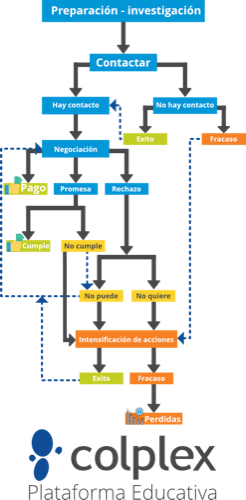
Once you have established a collection process, you can implement these 7 strategies at your educational institution to reduce payment delinquency:
- Before accepting a new student, request financial and credit information.
- Always keep fee payment information readily available
- Implement an effective monitoring system and maintain communication with parents
- Reward parents who keep up with payments
- Offer alternative payment options
- Keep your finances organized
- Implement administrative and financial management software for schools
1 Before accepting a new student, request financial and credit information.
This policy, adopted by many educational institutions, gives you a margin of security regarding the financial stability and credit history of the person responsible for payment.
Once this credit analysis is completed, a positive result could allow you to proceed to the next stages of admission.
Always bear in mind that families' financial circumstances can change at any time and that these financial assessments do not provide definitive guarantees.
2 Always keep fee payment information readily available
This delinquency management strategy is based on the fact that an effective collection policy becomes very difficult if the institution lacks the reports it needs when making strategic decisions. Having information about those who fail to pay makes it easier to continue the debt collection process.
3 Implement an effective monitoring system and maintain communication with parents
You can prevent many delays if those responsible for payment receive invoices on time, along with information about outstanding amounts and payment arrangements.
To send information about upcoming monthly fees or payment reminders to those who are behind, you can use technological tools and save on paperwork that rarely proves effective.
4 Reward parents who keep up with payments
You can establish discounts for timely payment. For example, offer a percentage discount on fees to those who pay for the month in advance. You can also offer a discount on a younger sibling's fees to families that stay current for 3 months, with the benefit withdrawn if a payment is late.
These are some ideas that will motivate many parents.
5 Offer alternative payment options
Some families may be going through difficult circumstances that prevent them from paying fees on the scheduled date. In these cases, you can offer an installment payment policy.
It is better to recover the amount owed in installments than let a larger debt accumulate, since every month it becomes harder for parents to catch up.
6 Keep your finances organized
Only by managing accounts payable and receivable effectively can you reduce payment delinquency at your school. When finances are managed in a disorganized way, it is easier for hidden debts to arise.
In the medium term, this can become a major problem, because the more time passes, the harder collection becomes.
7 Implement administrative and financial management software for schools
A digital tool with these features will let you manage your educational institution's administration and finances efficiently: automating collections, managing fees and debts, and keeping a record of income and expenditure transactions.
Automated management will lead to better management of payment delinquency at the institution.
Various types of software enable this kind of automation. We want to share the three best options, including their advantages and disadvantages.
Colplex

Colplex is the educational platform for schools, institutes, and universities. It automates institutions through academic, workforce, and financial management. Read more...
Advantages:
- Bank integration lets you view payments instantly within the platform.
- Comprehensive reports on people with outstanding payments.
- Parents can view their account statements in the mobile application.
- Automatic application of late fees.
- Management of internal cash registers.
GQdalya

The modular system of the educational and management platform GQdalya adapts to all types of schools or training centers. Modules are purchased according to each educational institution's needs, and any specific modifications needed can be made. Read more...
Advantages:
- You purchase only the modules you need.
- A comprehensive collection and billing center.
- Adaptations for special schools
Click edu

A cloud platform focused on educational institutions, making professionals' everyday tasks easier. It covers everything from academic to financial management, including communication with families. Read more...
Advantages:
- Receipts and invoices
- Financial management of cafeterias
- Financial management of school transportation use
- Online store
Conclusions
Implementing strategies to reduce payment delinquency helps minimize the effects these debts can have on your institution. This should undoubtedly be part of your risk management.
Good management of accounts payable and receivable can itself make the difference in managing your school's debts and ensuring your administration's success. Implementing digital tools will add value to your administrative and accounting management by optimizing all processes.