3 minutes
Teaching in institutional settings faces challenges qualitatively different from those encountered throughout its history. There may never have been as many tools to complement classroom learning as in the second decade of the 21st century, with the digital product boom.
Yet there has never been so much noise, nor so much confusing, irrelevant, or even false information mixed in with high-quality information. Ubiquitous screens, notifications, on-demand content, and competition for people's attention are not much help for teaching subjects in institutional settings either.
Although there is no substitute for in-person teaching within an institution—with its rhythms, community, and rituals—the resources used to complement it can influence students' performance at every level. In this context, podcasts are an excellent tool. As with all unregulated digital media, some productions are low quality or even have poor content, but there is a wealth of audio material perfect for classroom use or, better still, for complementing classroom time and even democratizing education.
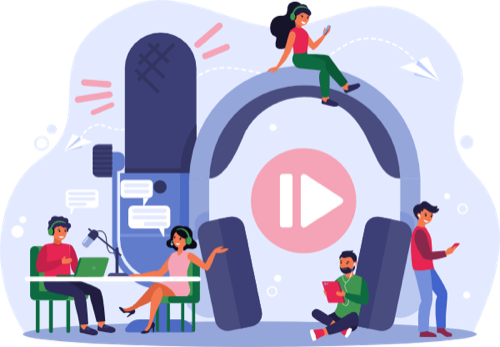
Podcasts are a tool for making lessons accessible, engaging, and informative for a wider variety of learners. They offer a simple way to absorb information and can keep students interested longer. Moreover, audio-only content demands a high level of attention: with podcasts, half-listening is not an option.
As mentioned above, podcasts can complement other forms of learning in a course and thus help accommodate varied teaching styles. In passive learning, they supplement customary reading and writing; in active learning, creating a podcast as coursework can be an excellent way to consolidate knowledge acquired in class.
Podcasts can help democratize education. Students can listen anywhere, anytime, so this content enables them to combine learning with their work schedules. Recording lessons and posting them through RSS lets students catch up if they could not attend.
Podcasts are flexible and can adapt to different teaching styles, communication skills, and teachers' aesthetic and narrative preferences. There is a wide range of possibilities when making a podcast. Besides lectures or storytelling, teachers can use dialogue to shape their podcasts, either with another subject specialist for a discussion or, conversely, with someone who knows nothing about the subject, to whom they explain a topic's key concepts.
Going much further, other options include humor, drama (magnificently achieved in Cronoficción), musical resources, or relevant audio documentation (as in the excellent productions Una habitación propia and Four more years).
Finally, higher education institutions can use podcasts to connect with their surrounding communities or even market themselves. In the Latin American world, this is still emerging, with some excellent examples such as the publication Cerosetentafrom Universidad de los Andes, Descarga Culturafrom UNAM, or the podcasts from Universidad de Tres de Febrero. In the United States, where podcasting is much more developed and has been for much longer, many universities have podcasts that have become reference points for general audiences in their subject areas, such as HBR IdeaCastfrom Harvard University.
In conclusion, podcasts open up a new spectrum of communication for every educational level, inside and outside the classroom, and for interaction between educational institutions and their surrounding communities.