
3 minutes
Welcome back to the Colplex blog! Today is a special day because we are celebrating International Chess Day. This ancient game has captivated people of every age and culture throughout history.
Beyond recreation, chess has remarkable educational benefits that make it a powerful tool for students' cognitive and emotional development. In this article, we explore how this game enriches the mind and spirit and how playing it can have a positive impact on children's and young people's learning.
♟️ Join us in this celebration of chess! 🎉

Developing logical thinking and concentration
Chess is a strategy game requiring planning, analysis, and careful decision-making.
As they play, students exercise logical thinking and learn to foresee the consequences of their moves.
This helps develop problem-solving skills and improve concentration, two essential aspects of learning.
Fostering creativity and imagination
Chess stimulates creativity and imagination. Moves and combinations of pieces can create unique, challenging positions on the board.
Students learn to explore different options and think outside conventional boundaries to find innovative solutions.
This ability to think creatively extends beyond the board and can be applied in various academic areas and everyday life.


Improving mathematical skills
Chess is closely linked to mathematical skills. Students must count and calculate to evaluate positions and make informed decisions.
Mathematical concepts such as symmetry, patterns, and geometry are also evident on the chessboard. Playing chess can be a fun, effective way to strengthen students' mathematical skills.
Learning self-control and patience
Chess teaches students the value of self-control and patience.
Learning to think before acting, wait for the right moment to move, and stay calm when facing different challenges is therefore key to winning the game.
These skills also carry over to daily life, where thoughtful decision-making and patience can lead to more satisfying outcomes.

Promoting social interaction and teamwork
Chess can be enjoyed alone, but it also encourages social interaction and teamwork. Students can play friendly games with classmates and learn to respect and value others' skills. Chess can also help build a sense of community and belonging in the classroom.
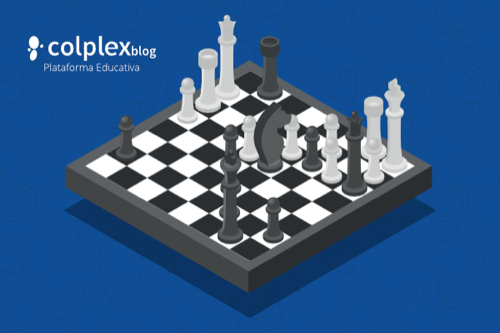
On this International Chess Day, we celebrate not only a strategy game but also a powerful educational tool that enriches students' minds and spirits.
Chess goes beyond moves on a board: it is a valuable learning resource that improves logical thinking, creativity, mathematical skills, self-control, and social interaction.
We invite all educators and students to include chess in their educational activities and enjoy the many benefits this ancient game offers.
Happy International Chess Day!