
4 minutes
New teaching methodologies are changing educational environments around the world and driving better academic results for students. We review some of the leading modern teaching methodologies developed by teachers that every 21st-century educator should know.
Flipped Classroom
One of the modern methodologies that has become most popular in recent years, the Flipped Classroom model is an educational model in which the traditional elements of a teacher-led lesson are reversed: students study the primary educational materials at home and then work on them in the classroom.
The main objective of this methodology is to optimize class time, devoting it, for example, to addressing each student's special needs, developing cooperative projects, or doing project work.
Project-Based Learning (PBL)
With the arrival of new information and communication technologies in schools, both new teaching methodologies and new versions of existing ones have emerged, now revised for digital generations. One of the most widely used in classrooms today is Project-Based Learning.
At its core, it allows students to acquire knowledge and key competencies by developing projects that address real-life problems.
Teaching based on projects or integrated tasks currently offers the best instructional guarantee of an effective contribution to developing key competencies and learning curricular content.
By starting with a specific, real problem rather than the traditional theoretical, abstract model, improvements in students' ability to retain knowledge seem evident, as does the opportunity to develop complex competencies such as critical thinking, communication, collaboration, and problem-solving.
Cooperative Learning
"Stronger together." That is a simple way to sum up cooperative learning, a methodology teachers use to group students and positively influence learning.
Proponents of this model theorize that working in groups improves students' attention, involvement, and acquisition of knowledge.
The ultimate objective is always shared, and it will be achieved if each member successfully carries out their tasks.
Its main feature is that it is structured around groups of 3–6 people, where each member has a specific role and achieving objectives requires interaction and coordinated work.
In cooperative learning, the ultimate objective is always shared, and it will be achieved if each member successfully carries out their tasks. In Individual Learning, by contrast, students focus on achieving their objectives without having to depend on their classmates.
Gamification
The integration of mechanics and dynamics from games and video games into non-game environments, or gamification, has been practiced for some time. In recent years, however, the phenomenon has reached an unprecedented scale, and it is a recurring choice among industry experts when analyzing current and future trends in technology-based education.
Since internationally oriented games such as the "Carmen Sandiego" series and "Reader Rabbit" gained worldwide popularity in the 1980s (see infographic below), the development of educational titles has multiplied—not only those aimed at the general population, but increasingly those aimed at specific students and courses.
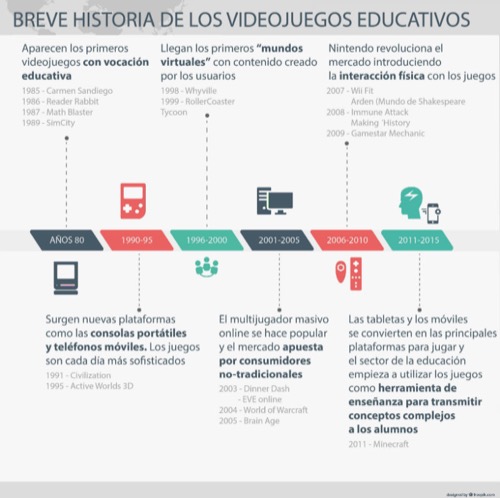
This trend was consolidated by the growing inclusion of gamification in school curricula, and that inclusion is expected to continue gaining importance in the future.
Problem-Based Learning
Problem-based learning is a cyclical learning process made up of many different stages, beginning with asking questions and acquiring knowledge, which in turn lead to more questions in a cycle of increasing complexity.
Putting this methodology into practice involves not only students' inquiry, but also turning it into useful data and information. According to numerous education specialists, the four major advantages observed with this methodology are:
- Developing critical thinking and creative competencies.
- Improving problem-solving skills.
- Increasing student motivation.
- Improving the ability to transfer knowledge to new situations.
Design Thinking
Education has always been a prime space for innovation. Teachers around the world are constantly bringing new ideas and methodologies into the classroom, making the best use of the tools available to them.
Design Thinking (DT) originated with designers and their method for solving problems to meet clients' needs. Applied to education, this model makes it possible to identify each student's individual problems more accurately and foster creation and innovation within their educational experience to meet others' needs.
Thinking-Based Learning
Beyond the debate over the effectiveness of learning "by heart," one of the most discussed aspects of education is the need to teach students to work with the information they receive at school. Teach them to contextualize, analyze, make connections, argue… In short, turn information into knowledge.
This is the objective of thinking-based learning: developing thinking skills beyond memorization, developing effective thinking.
Competency-Based Learning
By definition, all learning aims at acquiring knowledge, developing skills, and consolidating work habits. Competency-Based Learning represents a set of strategies for achieving this aim.
Through assessment tools such as rubrics, teachers can deliver the academic curriculum without departing from the current course of study but approach it differently, putting real examples into practice and thereby conveying to their students a more tangible dimension of the lessons.