
4 minutes
Teacher evaluation is a fundamental activity that encourages reflection, development, and proposals for continuous improvement in teaching.
Teacher evaluation promotes high-quality teaching through strategies for participation, dialogue, and agreement among those involved in the educational process: teachers, students, and principals.

Teacher evaluation gives teachers the opportunity to refine their educational practices in the teaching and learning process, improving their working styles, methods, and procedures to achieve meaningful student learning.
Why should you evaluate your teachers?
- Improves the quality of teaching.
- Encourages good teacher performance.
- Provides feedback on teacher performance.
How Can Teacher Performance Be Evaluated?
There are several established procedures for this type of evaluation:
- Through students' achievements.
- Through standardized instruments that measure teaching skills.
- Through students' opinions.
1 Evaluation through students' achievements:
This is the most common way to evaluate teacher performance. There is a relationship between a teacher's effectiveness and their students' success. Unfortunately, it is not the best way to evaluate a teacher's abilities: a student's success or failure does not depend exclusively on their teacher's positive or negative actions, but on a range of factors, with the teacher being just one of them. For example:
- The characteristics of the curriculum.
- The environment the student comes from.
- The student's ability and attitude.
That is why it is not valid to hold teachers entirely responsible for academic failure or success. Some students do not learn even with the best teachers.
2 Evaluation through tools that measure teaching skills:
Tests tend to measure a series of aspects believed to be related to teacher performance. These tests cover the following aspects:
- General information (general knowledge).
- Knowledge of educational theory.
- Knowledge of teaching methods, techniques, and procedures for instruction and evaluation.
- Resolving school situations and problems.
- Reading comprehension.
- Psychological and personality assessments.
3 Evaluating teacher performance through students' opinions:
Evaluating teachers through students' opinions is one of the most important procedures in this activity. However, it is also the most controversial. We will approach this issue by trying to answer a few questions:
Is it valid to evaluate teachers based on students' opinions?
Arguments have been written both for and against the validity of this form of evaluation. However, students are the best placed to evaluate teacher performance because they spend most of their time with teachers.
By interacting with teachers every day, students can provide very valuable information about their teachers' performance and abilities.
How should this evaluation be conducted?
A questionnaire is generally used to collect students' opinions about different aspects of the teacher's activities and personality. Certain precautions should be taken when administering it:
- Questionnaires must be anonymous.
- Students must be assured that the results will not be disclosed until the course has ended.
- Action should never be taken against a teacher immediately after a teacher evaluation.
Several tools can help streamline these processes. One is COLPLEX , which allows students to rate their teachers anonymously and securely, while enabling the results of these evaluations to be obtained automatically.
What can I do with the results of a teacher evaluation?
When a system offers achievable teaching improvement goals and opportunities for professional development, teachers will feel motivated to work toward them.
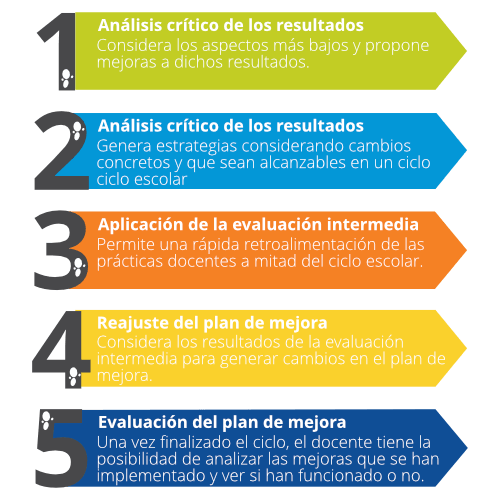
What benefits does an institution gain after conducting a teacher evaluation?
Teachers will improve their teaching methods, subject knowledge, roles as learning facilitators and mentors for young people, relationships with colleagues, and contributions to their institution's improvement projects.
In short, teacher evaluation makes it possible to:

For a teacher evaluation to help your educational institution, you should keep in mind that:
- It is important to begin with small changes envisioned as a long-term strategy.
- Reflecting on teaching helps teachers steer their practices toward improved learning.
- Teacher evaluation can have different uses, whether summative or formative.
- Using the results has great potential to bring about significant improvements in your educational institution.